
Why Not Be Comfortable?
By Jeff Morse, Green Meads Farm, Richmond, MA
First published in the Foothills Driving Club Newsletter, Issue 9, February 28, 2002
If there were one piece of advice I could give to all new drivers, it would be this: driving is supposed to be comfortable. One the surface, this seems sort of obvious. In fact, it is so obvious that the real meaning of it is often overlooked.
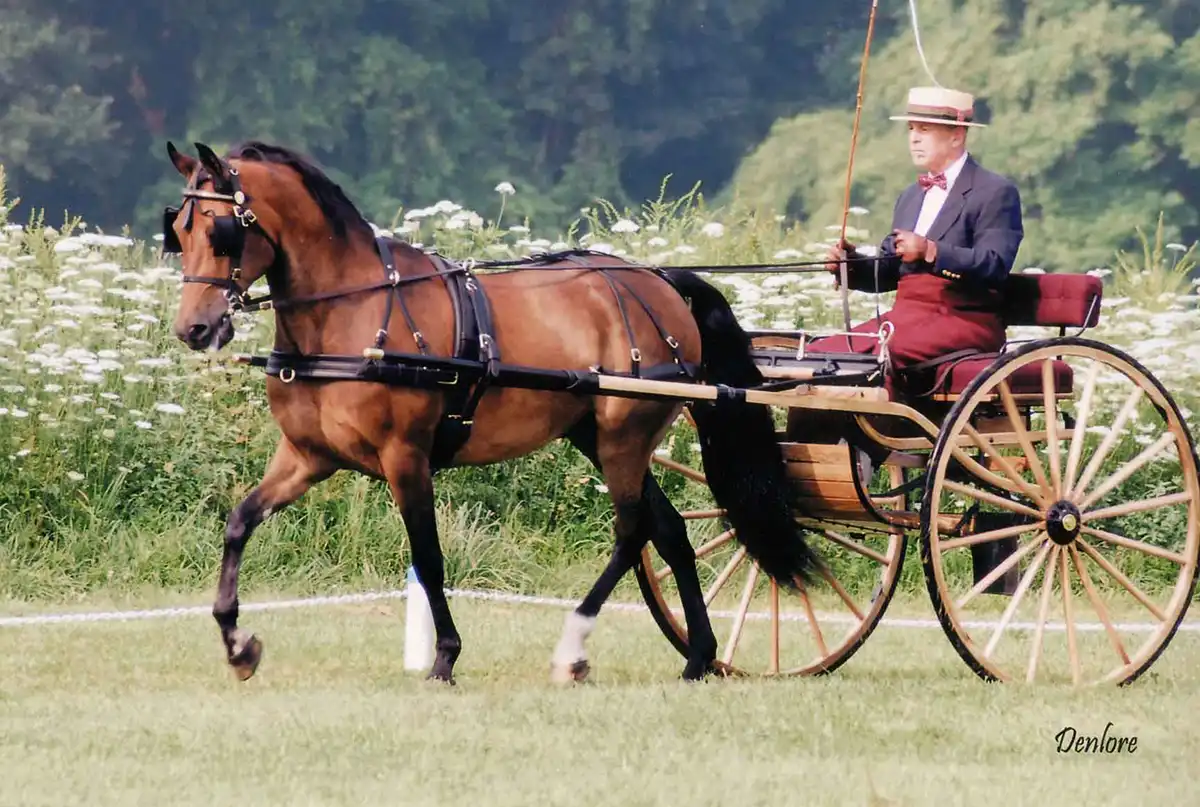
Driving is supposed to be comfortable for the driver.
For driving as a means of transportation this would make sense. Horses don’t travel very fast in relation to the motorized transportation speeds common today. That 10 minute trip to the grocery or hardware store might have taken an hour in the horse and buggy days. Drivers and their passengers certainly made all attempts to be as comfortable as they could. Vehicle makers extended every effort design comfort into their vehicles. The comfort of their vehicles was a selling point over their competition. Following the evolution of transportation comfort from the horse to the automobile, the comfort of one automobile over another is still a major selling point.
If you are not comfortable in the driver’s seat, your horse will feel it and, in many cases, it will react in ways that, in the very least, affect his efficiency to do the job you are asking, and perhaps react even in ways that jeopardize the safety of you, your passengers and your neighbors. Primarily I am referring to physical comfort. If you are tense or if you are trying to hold yourself in some awkward position while driving, you will not be able to take full advantage of the remarkably responsive and cooperative capacity of the horse’s mouth and brain. Your tension will interfere with the delivery of subtle yet powerful instructions from your hands thru the reins. Your horse will either object because he knows how the instructions should feel when delivered properly or the instructions will be confusing and perhaps even punishing to his mouth. If your hands are extended in front of you too far, they will become very heavy and your arms will become tired in short order while trying to hold them there. If you have stiffness in your back, your back will become a source of aggravation and not only will your horses performance begin to suffer, you will begin to find driving more of a chore and increasingly less enjoyable. Body position and the knowledge of what to do with your body while driving does not have quite as dramatic an effect on horse performance as a rider’s body position but its still crucial in terms of forming that winning relationship or union with your driving horse.
Driving is supposed to be comfortable for your horse.
If your horse is uncomfortable it is unfair to ask him to work. He can not deliver a good performance. It is important that you check your horse for pain and stiffness. One of the best times to do that is while grooming him. He will tell you if and where he is uncomfortable if you know how to listen. Pay attention to when he moves away from your curry or brush. If he curls his body away or moves parts of his body away from you as you groom him, that may not be a sign “it’s just the way he is” or “He just doesn’t like stiff brushes”. Horses LIKE to be groomed. It’s one of the ways horses give each other pleasure in the pasture. He may be telling you his muscles or joints are not feeling right. Likewise, when you put on his tack, does he move away or flinch when you approach? Does he dance around when you girth him up? Does he argue about putting the bridle on? These can be signs that he is uncomfortable. Check the fit of his tack. If you are unsure about where things really are supposed to go, ask someone to help you who knows. There is nothing like the guilt associated with having asked your horse to perform while you were oblivious to his discomfort all along.
One of the most important areas in your examination of your horse’s comfort is his mouth. With so many bits to choose from, bit fitting and selection can be a mysterious science. My best advice is to have someone who has a lot of experience with using many different bits help you find the one that is best for your horse. Bit selection is worthy of an article itself so I won’t cover it here. A clinic or lesson with a professional trainer will be well worth the money for this subject alone.
An Exercise In Comfort
Here is simple exercise that you can use for the rest of your life with both riding and driving horses. I set it up for drivers here. I am going to assume your horse is well broke to drive and familiar with his surroundings. Drive him into a field or in a large ring and set him in a straight line at the walk. Close your eyes. You can open them at any instant and opening your eyes is one of the fastest things you can physically do! So don’t be scared. Driving with you eyes closed, begin at your feet and check yourself for tension and for comfort and make any changes that seem right. Place one foot forward and one foot back underneath you. This will give you support in any direction as you are jostled about in the vehicle and will help prevent you from getting braced or getting top heavy. Move up your body, checking for flexibility and tension, making changes as you go. Let your weight drop down around your spine onto your butt cheeks. Take some of the weight off your feet and let gravity keep you on the seat. Let the motion of the vehicle move your body. Now sit up a little taller and find your balance. Play around with leaning forward and back and from side to side until you find a balance that feels right. Pay special attention to the middle of your back. Release tension and stiffness there. Hang your elbows at your side or slightly forward of vertical. Point your thumbs up and inward slightly. This may vary depending on how you are holding the reins and that alone is worthy of a separate article. But in general, look for a position of your arms and hands that feels comfortable. Now’s the time to experiment. Open your eyes. That’s it. Now look at your horse. Nine times out of 10, he will be more relaxed, more supple and will have lowered his head and neck.
The next time you do this exercise, give a quick check of your self, then pay attention to what you can feel in your hands. Your horse uses his head and neck to help him balance as he walks. You should feel his head moving thru the rein in your hand. Let that motion move your hands and arms while at the same time maintaining a connection to your horse thru the rein. This may take a little practice. But it will plant the feel of this kind of connection in the subconscious part of your brain. This is useful because if you try to too hard to work at that connection or force it to happen, you will not be successful. And once again, when you open your eyes, you horse most likely will have changed in a very positive way.
In Conclusion
After your drive pay attention to how you feel. Often in the “heat of the battle”, our attention is focused so intently on the horse in front of us that we fail to pay attention to some aspects of ourselves that have a powerful influence on how our horse behaves when we drive him. Are your fingers cramped, tired, stiff sore? Are your biceps tired? Is your back stiff? Do you find
yourself stretching when you get down from the seat? Are your extremities cold? (Poor blood circulation can be sign of stiffness and tension) Does your neck hurt? Next time you drive, close your eyes and you should be able to find the source of your discomfort. You should not feel stressed after driving. Quite the opposite! You should feel relaxed. Driving should be comfortable.
(This article has been republished with permission from the author for this Trader Issue.)